6 Ways to Discover Local Products All Year Long6 façons de découvrir les produits d’ici toute l’année

On June 12, J’achète un produit québécois! invites us to take a simple action: choose a local product. Beyond a one-time purchase, this day can become an opportunity to reflect on our habits and on our connection with local artisans and businesses.


Here are 6 simple ways to discover and incorporate Québec-made products into your daily life on June 12 — and throughout the rest of the year.


1. Learn How to Identify Local Products
One of the first habits to develop is taking the time to check where the products we buy come from.

At the grocery store, in boutiques, at markets, or even online, certain logos can help guide us. Labels such as Aliments du Québec, Aliments préparés au Québec, Produit du Québec, Fabriqué au Québec, or Conçu au Québec make it easier to recognize products that showcase local expertise and craftsmanship.

It’s a simple way to avoid assumptions and better understand what we’re putting in our shopping carts.


2. Visit Public Markets and Farm Stands
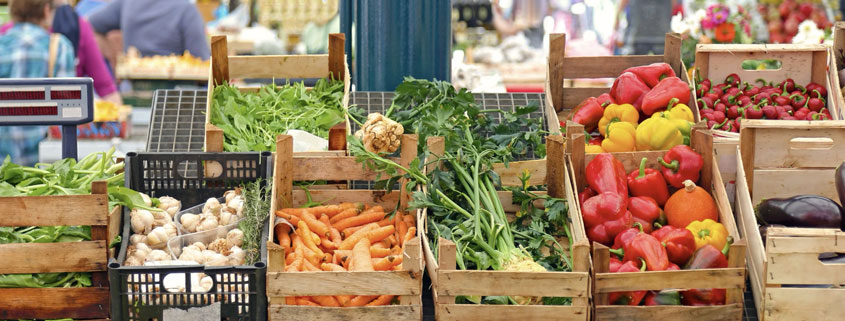
Public markets, farm stands, pick-your-own farms, and farm baskets are excellent ways to discover Québec products.

You’ll find fruits, vegetables, meat, cheese, bread, processed foods, and many other local products. It’s also a great way to better understand seasonality. We quickly realize that available products change from week to week, depending on harvests and regions. Buying local then becomes a meaningful way to reconnect with the rhythm of the seasons.


3. Attend Agricultural, Food, or Gourmet Events
Throughout the year, many events provide opportunities to discover local products and meet the people who create them.

These include gourmet fairs, harvest festivals, seasonal markets, tastings, and regional events that showcase the work of producers and artisans.

The Open Farm Day organized by the Union des producteurs agricoles takes place every September and offers visitors an immersive experience at participating farms across Québec.


4. Explore Regional Routes and Circuits
Québec is full of gourmet routes, agritourism circuits, and regional trails that allow people to discover local products in a different way.

Wine routes, Circuits du paysan, flavor trails, vineyard tours, cider houses, sugar shacks, farms, and honey houses are just a few examples of the many possibilities available.

These outings turn buying local into a discovery experience rather than just another grocery list.


5. Replace One Product at a Time in Your Habits
Buying Québec-made products can seem intimidating if we think we need to change everything all at once. A much simpler approach is to replace one product at a time.

You can start with something you buy regularly: jam, flour, cheese, soap, herbal tea, household products, or seasonal vegetables, for example.

The idea is simply to develop new habits gradually.


6. Give Québec-Made Gifts
Gifts can be a natural gateway to discovering Québec brands.

Local products offer a wide variety of options: processed foods, terroir products, books, handmade items, body care products, regional experiences, and much more.

It’s also a wonderful way to extend the impact of buying local. Someone who receives a Québec product as a gift may, in turn, discover a business they’ll want to support again in the future.


The J’achète un produit québécois day is a great opportunity to take meaningful action, but it can also become the starting point for a broader reflection on our consumption habits


On June 12, why not start with one simple gesture?
 

Adapting to the Unpredictable: The Real Challenge of Spring

Spring has a reputation for setting everything back in motion. The light returns, the days grow longer, and energy slowly comes back. After months of winter, we often talk about renewal and fresh starts.

But on the farm, it’s also a season when everything seems to happen at once, and unpredictability often sets the pace for us.

Because in agriculture, even with all the organization in the world, there will always be something beyond our control: the weather, breakdowns, delays, emergencies, or simply the fatigue that eventually catches up with us.

Spring farming never follows a perfect plan. One rainy day can impact an entire week. One unexpected issue can push back three other tasks. While we try to catch up, other responsibilities continue moving forward as well.

What if the real challenge of spring wasn’t controlling everything, but rather learning to adapt to the unpredictable?


A Few Ways to Reduce Daily Pressure
The goal is not to eliminate 100% of spring chaos, but to adopt habits that can help prevent overwhelm from taking over


1. Focus on 3 realistic priorities
Instead of trying to do everything in one day, identify three or four essential tasks. Everything else becomes a bonus.

It may sound simple, but it can help reduce the constant feeling of being “behind.”


2. Plan — but not too much
Planning every minute of the day often leads to frustration.
Instead, try planning in broad blocks:
morning
afternoon
priority tasks
secondary tasks

This leaves room to adapt when the day suddenly changes direction (because let’s be honest, that happens often!).


3. Leave room for the unexpected
We often underestimate how long things actually take.
If a task seems like it will take an hour, allowing a little extra time can help avoid the domino effect where one delay throws off the entire day.


4. Reset halfway through the day
When everything piles up, we often keep running without taking time to reassess. Sometimes, stopping for 10 minutes to review priorities can prevent ending the day completely exhausted.


5. Keep a small self-care moment for yourself
You don’t need a perfect wellness routine — simply taking a small moment to reconnect with yourself can make a difference:
drink your coffee sitting down for a few minutes;
listen to a podcast while doing a task (we know a pretty good one 😉);
get some fresh air without a specific goal;
allow yourself to take a break when fatigue kicks in.

Spring doesn’t need to be perfectly managed to be successful. It can be intense, unpredictable, sometimes even chaotic, and still bring beautiful things.

Most importantly, remember that you do not have to go through this season alone. Talking things through, asking for advice, sharing challenges, or simply feeling understood can make all the difference.
Les Agricultrices du Québec are also here for that: to create spaces where women in agriculture can support one another, learn from each other, and move forward together, one season at a time.

Jamie Fraser: Raising sheep — and awareness of role of farmers — in Nova Scotia

Brenda O’Farrell
Special to Agricultrices du Québec


If there was a typical Nova Scotia farmer, Jamie Fraser would not fit the mold.

The 39-year-old holds a master’s degree in science and an undergraduate degree in aqua-culture from the University of Dalhousie and now works full time at the institution’s agricultural campus, one of the leading research institutions in the field in Canada.

In her spare time, she farms.

“If I could — and I had a $1 million — I would definitely farm full time,” Fraser said.

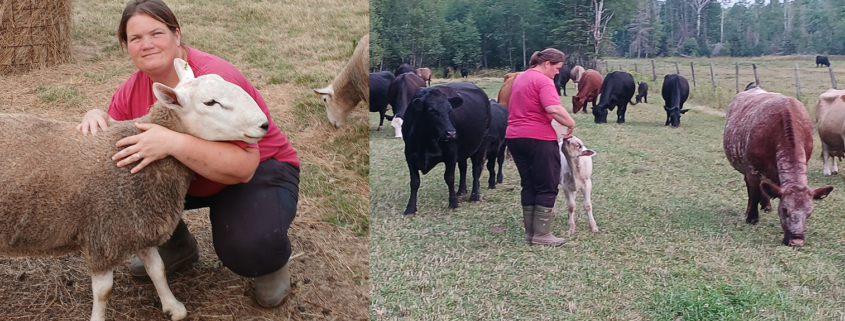
Fraser raises sheep on a farm she operates with her brother, who tends a beef herd of about 40. The farm is owned by their mother and is located in Tatamagouche, a small town about 50 kilometres north of Truro and west of Pictou along the Northumberland Strait, which separates Nova Scotia from Prince Edward Island.

She has no hesitation in describing her relationship with farming as her hobby.

“I find work uses my education and keeps my brain kinda moving,” Fraser said, referring to her day job at the agricultural campus, where she is the manager of the feed mill that develops and produces animal feeds, often working with novel ingredients.

“I use my work to pay for things, and it’s my pension plan,” she explained. “My hobby is farming. I like being around animals.”

“I don’t know what I would do if I didn’t have the farm to work on.”

But Fraser does not just work on the farm and tend to her sheep, she is also active in a number of farming organizations. She is a member of the board of the Sheep Producers Association of Nova Scotia, the vice-president of the Purebred Sheep Breeders Association of Nova Scotia, the beef and sheep leader for the 4-H Club, a member of the Northumberland Sheep Producers Association, which organizes the annual Pictou Sheep Show and Christmas dinner and auction.

All of that involvement has made her an advocate for supporting local producers.

“I want people to support Canadian-grown food,” she said, explaining much work is needed to ensure average consumers not only buy Canadian, but understand the quality of the food produced in this country.
“They need more connection to realize how it’s produced,” she said, adding that more people, non-farmers, could get involved in the sector.

“A lot of jobs are available in agriculture, but people are not getting involved because they don’t know about it,” she explained.

When asked if more women should get involved in farming, she responded: “I’ve always known women to be involved in agriculture. I’ve never seen women not involved.”
And when it comes to her subsector of production, she acknowledges that there are a lot more women than men in sheep production, compared with beef production, for example, which is dominated by men.

Fraser is optimistic about women’s place in the future of farming, especially in the sheep sector, an area that has room for expansion in Canada, she said. But that does not mean she is not worried about the future of farming in general in this country.

“My one fear is that a lot of larger companies will take it over,” she said. “That is my one worry.”

It is perhaps that worry that spurs her to keep doing what she does, and on the scale she does it. It is perhaps what justifies why she gets up every morning to do chores on the farm before going out to her job at 8 a.m., and then returns home to do more chores, head to the hay fields till about 10 and, on some days, then fix an electric fence until about midnight. And then do it all again the next day.

Karen Temple: Taking on challenges of raising goats in Yukon

Brenda O’Farrell
Special to Agricultrices du Québec


Farming in the Yukon is not for the faint of heart, nor is it done on a large scale, and that is just fine with Karen Temple.

In a place where below-freezing temperatures usually stretch from October to March, which leaves a growing season limited to June and July, raising livestock has its unique challenges. But Temple has jumped in with both feet.

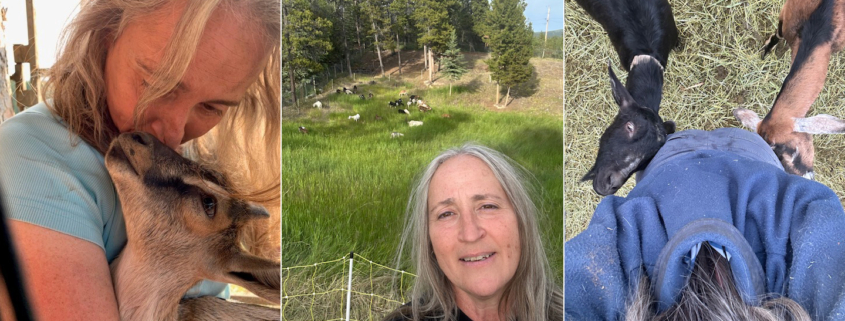
The 56-year-old runs Sunny Spot Farm with her husband, Chance Temple. Established in 2021, it is one of just a few farms with goats in Canada’s westernmost territory, which finds its northern corner hovering above the Arctic Circle. It is a small operation, just under nine acres, with a herd of about 125. But Temple has no shortage of enthusiasm.

“I love goats. I just love goats,” she said.

And the market for goat meat is growing, she explained, especially among the territory’s growing immigrant population. Since the early 2000s, the territory has seen a boost in its Asian population, including a significant portion arriving from the Philippines.

“Sixty per cent of the world eats goat,” Temple said, “just not North America and Europe.”

But despite Temple’s enthusiasm for raising goats, the reality of the North does not make it easy.

According to Statistics Canada, the Yukon, which has a population of just below 47,000, had only 88 farms in 2021, and only a few raise goats. In fact, unlike in the rest of Canada, which has a long history of generational farming, there were no farms in the territory before 1898. And today there is only one dairy farm and a single federally-inspected egg-producing operation.

Temple’s farm is located in Marsh Lake, a community of about 750 people southeast of the capital Whitehorse. The property is south of the Alaska Highway, which cuts through the southern part of the territory, and the Yukon River. It is located on a rural road, four kilometres from the nearest power line, which means they live off-the-grid, generating their own auxiliary power, which pumps water from private wells.

“It’s harsh,” admitted Temple, who grew up on a hobby farm in Armstrong, B.C., southeast of Kamloops. “We are the pioneers of farming in Yukon.”

That pioneering spirit is what gets them through the winter months, which require them to purchase enough hay to get their herd through it.

The goats grow what Temple calls “fuzzy coats” in the deep-freeze months. “When its minus-30, they kind of lay down, get up to eat and then lay down together,” she said, explaining that the goats stay outside most of the time, but have access to an unheated, insulated barn. Making sure they have access to water, without it freezing over, is a constant chore.

“The resources to support us are not there,” she said.

The lack of veterinarians and strict regulations, like the territory’s Sheep and Goat Control Order, which came into effect in January, make goat farming that much more difficult.

The latest control order follows on the heels of the original order that dates back to 2020. It’s a measure imposed under the territorial government’s Animal Health Act that aims to reduce the risk of exposing wild sheep and mountain goats to respiratory pathogens that can be carried by healthy domestic sheep and goats. Temple said the rules require goat farmers to keep their animals behind two lines of fencing at all time. This has made the logistics of expanding her heard by offering a grazing and weed control service to clean up lots owned by others more difficult.

But she is doing just that for the first time this summer nonetheless, using lines of temporary mesh fencing. She said she simply put out a call, saying she was looking for hay and places to graze her goats. The practice allows her to reduce her daily feeding costs, and, as she says, “it’s good for the goats.”

The practice is part of her business plan, which she put together when they launched the farm.

“We’re pretty much on track,” Temple said, referring to her business plan. But then offers a qualifier: “The farm lost less money last year.”

But Temple is undeterred. She is determined to maintain her status of a farmer in a part of the country where the practice is just still burgeoning and which she has called home since she was 19.

“It’s interesting to be somewhere where something has not ever happened before.”