
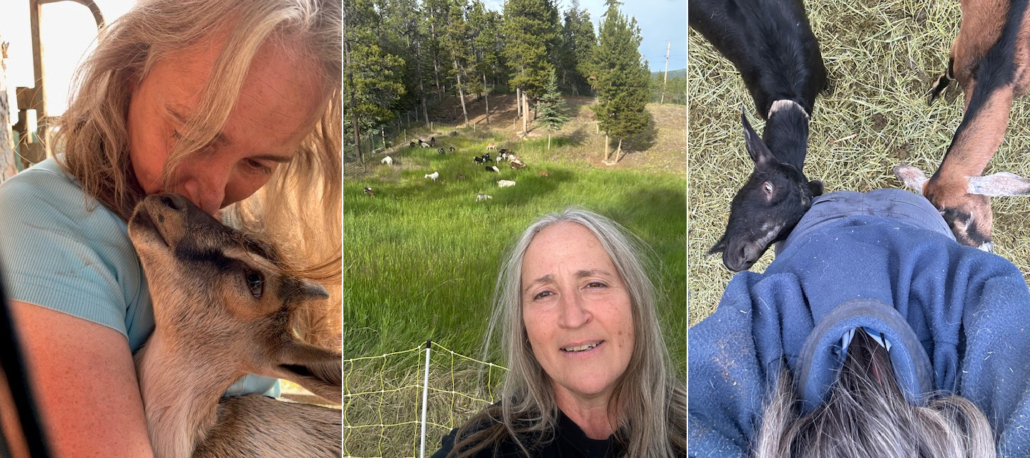
Karen Temple: Taking on challenges of raising goats in Yukon
Brenda O’Farrell
Special to Agricultrices du Québec
Farming in the Yukon is not for the faint of heart, nor is it done on a large scale, and that is just fine with Karen Temple.
In a place where below-freezing temperatures usually stretch from October to March, which leaves a growing season limited to June and July, raising livestock has its unique challenges. But Temple has jumped in with both feet.
The 56-year-old runs Sunny Spot Farm with her husband, Chance Temple. Established in 2021, it is one of just a few farms with goats in Canada’s westernmost territory, which finds its northern corner hovering above the Arctic Circle. It is a small operation, just under nine acres, with a herd of about 125. But Temple has no shortage of enthusiasm.
“I love goats. I just love goats,” she said.
And the market for goat meat is growing, she explained, especially among the territory’s growing immigrant population. Since the early 2000s, the territory has seen a boost in its Asian population, including a significant portion arriving from the Philippines.
“Sixty per cent of the world eats goat,” Temple said, “just not North America and Europe.”
But despite Temple’s enthusiasm for raising goats, the reality of the North does not make it easy.
According to Statistics Canada, the Yukon, which has a population of just below 47,000, had only 88 farms in 2021, and only a few raise goats. In fact, unlike in the rest of Canada, which has a long history of generational farming, there were no farms in the territory before 1898. And today there is only one dairy farm and a single federally-inspected egg-producing operation.
Temple’s farm is located in Marsh Lake, a community of about 750 people southeast of the capital Whitehorse. The property is south of the Alaska Highway, which cuts through the southern part of the territory, and the Yukon River. It is located on a rural road, four kilometres from the nearest power line, which means they live off-the-grid, generating their own auxiliary power, which pumps water from private wells.
“It’s harsh,” admitted Temple, who grew up on a hobby farm in Armstrong, B.C., southeast of Kamloops. “We are the pioneers of farming in Yukon.”
That pioneering spirit is what gets them through the winter months, which require them to purchase enough hay to get their herd through it.
The goats grow what Temple calls “fuzzy coats” in the deep-freeze months. “When its minus-30, they kind of lay down, get up to eat and then lay down together,” she said, explaining that the goats stay outside most of the time, but have access to an unheated, insulated barn. Making sure they have access to water, without it freezing over, is a constant chore.
“The resources to support us are not there,” she said.
The lack of veterinarians and strict regulations, like the territory’s Sheep and Goat Control Order, which came into effect in January, make goat farming that much more difficult.
The latest control order follows on the heels of the original order that dates back to 2020. It’s a measure imposed under the territorial government’s Animal Health Act that aims to reduce the risk of exposing wild sheep and mountain goats to respiratory pathogens that can be carried by healthy domestic sheep and goats. Temple said the rules require goat farmers to keep their animals behind two lines of fencing at all time. This has made the logistics of expanding her heard by offering a grazing and weed control service to clean up lots owned by others more difficult.
But she is doing just that for the first time this summer nonetheless, using lines of temporary mesh fencing. She said she simply put out a call, saying she was looking for hay and places to graze her goats. The practice allows her to reduce her daily feeding costs, and, as she says, “it’s good for the goats.”
The practice is part of her business plan, which she put together when they launched the farm.
“We’re pretty much on track,” Temple said, referring to her business plan. But then offers a qualifier: “The farm lost less money last year.”
But Temple is undeterred. She is determined to maintain her status of a farmer in a part of the country where the practice is just still burgeoning and which she has called home since she was 19.
“It’s interesting to be somewhere where something has not ever happened before.”




Leave a Reply
Want to join the discussion?Feel free to contribute!